Wednesday, September 3, 2014

Reed Dancing


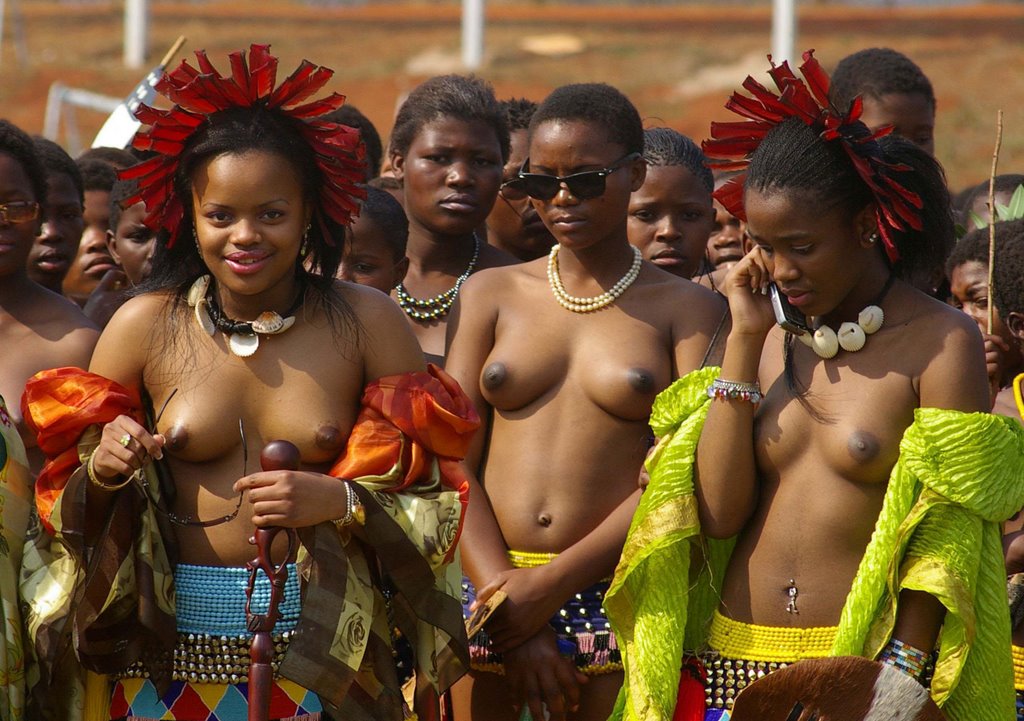
I was sitting at home this week watching the kombies and open-backed lorries go past, cram-full of excited singing girls on their way to umhlanga, and thinking, ‘Yes, it’s that time again.’
 
Tomorrow the public and plenty of tourists will be watching these girls, along with thousands of others, dance and dance and dance until the excitement is in everybody’s heads and streaming from the skins of perspiration into the air. There will be noise and glamour and all the thrill of a big day long-awaited. But that will not be the main event. The main event is today, when the reeds are delivered to the Queen mother’s kraal.
 
One of the earliest cosmological narratives collected from this part of the world is that of God creating people from reeds. In this story, the world was already formed but without people and so God went down to the river’s edge and created humans from the tall reeds that were growing there. It is Southern Africa’s parallel to the Genesis account of people being made from clay.
 
The story is remembered in the clan praise-title, Wena Weluhlanga, ‘You (people) of the reed’, and this is the true significance of Umhlanga, the Reed Dance. The week’s events are in fact a celebration of our common beginning and continued existence, a modern echo of an ancient story. When the tribes began to settle down in this region and build more or less permanent homesteads and collect cattle, the defining technology was in the creative use of reeds and grass for building and thatching. That is still a defining technology in the rural areas because cattle and their kraals are still central to Swaziland’s homesteads and culture (think, for example, of the old Tinkhundla elections, when candidates sat in front of kraals and voters went inside those kraals to be counted). Reeds therefore are one of our central focusing images.
 
The dancing, then, is not what the event is really all about, although it is the flashing breasts and plumping buttocks—framed in the vibrancy of blue and overwhelming red—that attract the eyes and the cameras of visitors.
 
Yet the dancing is not without significance, for dancing is a sign of vibrant life: if you look at a bed of reeds moving in the wind you can imagine them dancing, and that’s an apt image for life itself. The reeds are animated, alive because they have movement. Death, after all, is supremely a stillness. Life can be seen therefore as a kind of dance: sometimes a noisy, crazy, careering one, but still a dance.
 
There are, I know, many critics of this annual national event, who either believe the Dance belongs too firmly in the past to make sense in the present or else squirm uneasily to see so much young flesh shaking and quivering in public view. But the Dance—precisely because it has links to the creation myth—is one of the bedrocks of what it means to be Swazi and southern African. In an era when so many trumpet the call of being unique and presenting an authentic voice within our global village, it is only Umhlanga and iNcwala (and really not so much else) that provide the links and foundations for national and individual identity. It is when the nation’s origins and persuasions are on display. Today and tomorrow then, it is not only the girls but also the whole nation that will be dancing. By watching the swaying, jostling, singing girls at Umhlanga and imagining them as that amazing thing, a bed of living reeds, we can deepen our understanding, and perhaps regain something of the wonder of life itself.

© Kenneth Rowley 2014 (originally published Saturday, September 02, 2006)


Sunday, August 31, 2014

Signs of the Times

(source: Times of Swaziland)
This photo was in the Swazi Times during the week, showing some of the maidens arriving to participate in Umhlanga (the Reed Dance). At the time, I thought nothing of it, but earlier today I was down in the Lobamba area and I realised just how significant the photo is. There were plenty of girls around earlier today, even around the Gables supermarkets, and they all looked liked this: western clothing, with emahiya (traditional patterned cloth) packed away to be worn only during the ceremony. I was fortunate enough to experience an Umhlanga during King Sobhuza's time, and in the country in those days emahiya and even emajobo (part of traditional male clothing) were common everyday sights even in the towns and cities; not now. Even just a few hours before today's main event (today was the 'real' day of course, the delivery of reeds) emahiya-wearing was about 2% everywhere I was. Times have changed. Umhlanga is now an event like AIDS day or Valentine's day, not something arising naturally out of our country's culture. (& BTW, have you noticed how the numbers of girls attending -- according to the papers' headlines -- have been decreasing by between 10 000 and 15 000 each year?)

It would be interesting to know how many Swazi folktales and other fundamentals of oral literature these modern girls know; for sure they know all about Rihanna, Lil' Wayne, and Niki Minaj (whose recent video has already been downloaded 100 times more than Swaziland's total population). As we move more and more towards a global village, so the unique details of a culture tend to disappear, swallowed up by the greater whole. Or, as some have put it, we all know more and more about less and less.

Friday, July 25, 2014

Mac-like

Mac-like 


 Everybody knows that Apple is the Rolls-Royce of computing. When I encountered my first Mac, back in early 1985, every computer I had ever used before became a second-class citizen. And even when Apple's fortunes hit rock bottom in the dark nineties (do you remember a pic of a Windows install disc with the legend, "One OS to rule them all, and in the darkness bind them"?) the Mac refused to die. Why? I've always believed it was a combination of three things: 

a Mac always worked straight out of the box; 
a Mac always expressed the Human Interface Guidelines (HIG) that stood behind it; 
and, if you had the courage and a little bit of skill, a Mac could always be tweaked

My favourite Mac OS was OS 7; my favourite Mac program was the experimental but amazing Cyberdog (an Internet suite built to demonstrate the concept and power of OpenDoc). Cyberdog was a joint project of Apple and IBM and it was killed off c.1997 by Microsoft pressure; Windows 8 reminds me of it everytime I see a new WinBox. Anyway, now it's 2014 and I still have my Macs. But I now also have linux. My first linux love was Bianca (2.2) and I still use Mint (Quiana 17 is on a partition of this machine). But now linux also has its own OS 7. It's name is elementary OS.

Wednesday, July 31, 2013

I was so happy

I was so happy I was so happy
seeing you again
seeing you again
that the image
now haunts my brain
like a watermark
or the acidic stain
left by an accidental spill
of the choicest wine.

In time
the image
may fade
but I wouldn't count on it;
your life
your life
is in that image
and everything that you were
or ever will be
to me
is there
for me to see
on the other side of my eyelids
whenever I close my eyes.

c Kenneth Rowley 2013

Saturday, July 27, 2013

How to disable Windows 8 'Secure Boot' etc and install Ubuntu, Mint or Peppermint

You've bought a laptop that came with Windows 8 pre-installed on it and now you're tearing your hair out? There's hope (though maybe not so much with the hair replacement). Although Windows 8 ships with a 'Secure Boot' setup that suggests you can't install anything else on the machine (not even go back to Windows 7 or good ol' XP heehe) it's actually quite easy to disable this and install whatever you like. All you need to do is turn the computer off and restart it with the F2 key held down. This will active the BIOS, where you can switch off the 'Secure Boot' and switch to Legacy OS, which means you can use your installers CDs just like you used to, or gparted or whatever. It took me just a few minutes...

I'm posting this from a Lenovo G580 running Linux Mint 14 (Maya). No problems.

Friday, July 26, 2013

for the record

Just for the record, currently I use a MacBook, an iPad, an Android phone (Samsung S2), and a cheap box that came pre-installed with Windows Vista but  now has Linux Mint 14, Peppermint 4, and Ubuntu 14 installed on it (no Windows).

Why Windows is in trouble...

Many commentators think Windows is in trouble because Windows 8 is proving so unpopular that some companies are making money by uninstalling 8 and replacing it with 7. Others point to the fact that Microsoft's Secure Boot option (sic) is really a way to try and stop users dual-booting their machines by installing linux, for example, on a new partition. Still others claim that desktop machines are already obsolete and Windows has very little mobile presence.

But the real reason that Windows is in trouble is that OS X and Android are close cousins.

Consider, for example, a mobile programmer. Let's say he writes his new app in python, a flexible language for such apps. He writes it first for iPhone and iPad; which means it will run on a UNIX core. If he then wants to release an Android version, it's not that difficult (I'm not saying it's easy) because Android is a LINUX flavour, and linux derives from unix. But if somebody then asks him for a Windows version...

This is the main reason why Apple and Google are the two giants fighting for mobile dominance at the moment.

Apple struggled prior to OS X, but the switch to a UNIX core helped reverse its fortunes. And Windows 8 boxes-- such as the Lenovo Thinkpads--are ideal platforms for running linux.

Thursday, July 11, 2013

I See Hawks in LA: 'Mystery Drug' Review


I See Hawks In LA Mystery Drug:

I first came across I See Hawks when they released their second album, years ago, but because I live in Swaziland, all I could get hold of were a few songs on the band's website including I See Hawks In LA and Humboldt. I thought they were a neo-Flying Burrito Brothers and told them so. More recently I was in London and found a copy of last year's New Kind of Lonely. I'll be honest; I'm a fan. But, like the Burritos, they're still likely to appeal more to musicians than the general public. (I bought two copies of the Burrito's Gilded Palace of Sin when it was first released and gave one to my brother. He appreciated the gesture but was bemused by the music.) But how can I not like a band who releases songs with lyrics like these:

“Stop driving like an asshole/ You know who you are/ Did you think when you cut me off it would help you go farther? / You’re an accident waiting to happen, a flipped over SUV/ On the 405, at six o’clock, your carcass on TV…. The angels will sing/ sha-la-la, sha-la-la/ he drove like an asshole"?

That's on Mystery Drug. For many bands it might be seen as a cheap throwaway, but it's typical of the band's leftfield approach. The Hawks are listed as Alt. Country, or hippie country and it's rare for a reviewer not to mention the Burritos, but they have this whole other dimension that I call Zen Country, an off-the-wall insight or irreverent comment that lingers long after you've heard it. 

Already I love this album. And when some other driver cuts me off...

Wednesday, June 19, 2013

The future of pop music


'Amo Noite e Dia' by Oba Oba Samba House

The other day I was thinking of three album titles that are likely not to appear on iTunes anytime soon: 'Chris Brown sings Rihanna', 'Jay-Z: the Reggae Album', and 'Niki Minaj: Worship Live at the Pentecostal Worship Center, Los Angeles', and wondering why this is so. Music is so niche-nuanced these days; mention the name of an artist and you already know what you're getting.

It wasn't always this way. There was a time when pop music was genuinely popular; that is, you didn't have 'hip-hop' charts, 'urban', 'smooth jazz', 'country', 'electro', 'kwaito', and a zillion other categories. No, there was a time when 'pop' embraced everything. The Beatles, for example, wrote reggae songs, Ray Charles sang country; and Aretha sang gospel and latin as well as soul. And everyone heard it all. In those bygone days, listening to the radio meant the whole family was catered for -- the kids, the teens, the mums-and-dads and even the grannies could expect to hear their current favourite songs being played by familiar corny-joke DJs.

But not, it seems, any more. What brought about this narrowing of focus, this fragmentation of music into many parts? Well, of course there are a lot more people in the world now -- seven billion or so, and they all like what they like; and there's a heck of a lot more music too. But I suspect the biggest instigator of the change is technology. When radio was the big thing, the unifying force that it was, it was partly because there wasn't anything else. If you wanted portable music, music on the go, it had to be from a transistor radio. There were no Walkmans, iPods, iPads or even beatboxes. Now it appears that half the world walks around with wires sprouting from their ears. I even saw a hoodie advertised recently that comes with earphones built-in -- 'fully washable', according to the blurb.

Yet I've seen, I think, a glimmer of change, and that's why I think bands like Oba Oba Samba House are the future of pop. 'Amo Noite e Dia' begins with that ubiquitous 4/4 House thump, but a short way through suddenly becomes a samba song. The words are in Portuguese (the title means 'I love [you] night and day'), but the band (they're from Brazil) sing convincingly in English too (check out their reworking of Kings of Leon's Use Somebody). I like the way they're bilingual and eclectic -- Portuguese bleeds into English and Rock sits side-by-side with House, Samba, and boy-band vocals. Oh, and perhaps most embracingly of all, they also manage to include the tradiditional Brazilian tiny guitar (cavaquinho) in their instrumentation and sound. Their albums bang like a mixtape, and I love it. Everything is back in the mix again. They are, to me, a miniature musical representation of the sprawling Internet, the way everything is available, all jumbled up, all up for grabs. And, as they should be, they're fun. Their sound should be chaotic, anarchic, but it's not; what they do shouldn't work, but it does; somehow what should be an unmanageable collision of languages and styles finds a sense of order. They are truly a band for the Internet age. So, welcome to updated radio. Oba Oba Samba House are the sound of our future.

Monday, March 11, 2013

Clickety-Clicks


Clickety-Clicks

That was the day I clicked with the girl from Clicks. I didn’t recognise her at first. No, that’s wrong; I did recognise her, but I didn’t know where from; she wasn’t wearing her pharmacist’s uniform. And without her uniform...
   She was dressed casually, not fussily, presumably for comfort rather than to impress. Her jeans were faded and worn from use—not bought that way—and her top was a bright mass-produced one you could buy at any common clothing chain like Identity or Jet or Mr Price. Her blue shoes were stylish though.
   She smiled at me, a good start. I started; stared; then smiled back.
“What’s wrong?” she asked. I was still trying to work out where she was from.
“Nothing... you’re the pharmacist from Clicks?”
“Yes, and you’re one of my customers. How’s the migraine?”
“Oh, it’s gone now, thanks. You helped.”
“That’s my job.” She smiled again.
“Yes, I suppose so.”
   It was at this point that nothing happened. No, that’s wrong; plenty was happening, but we were

feeling it, not talking, not moving, just looking at each other and feeling.
“Look, why don’t...” We spoke together; realised what we’d done; looked again at each other; and

laughed.
“You first,” I said.
“No, you,” she said.
“Well,” I started again, “what are you doing now? From here?”
“Just girlie things.”
“Shopping, you mean.”
“Uh-huh. Do you want to buy me something?”
“Uh, like what?”
“What girls like. Shoes, jeans, an engagement ring...” I tried to ignore the last item.
“Underwear?” I said.
“That’s what men like. You’re always thinking of undressed women.”
“Me? No, I was joking.”
“You weren’t, but it’s OK. I like a man to be a man.”
“Let’s keep talking,” I said.
“OK.”
   We went where we could talk. We went to a café and got a drink. No, that’s obviously wrong. We got 
two drinks: hers was a juice; mine was an appletiser.
   Then we talked. And laughed. And talked. And laughed. And got some other drinks. And discovered
we liked similar music, had read similar books, and wanted exactly the same thing.
   What was that thing? Well, let’s just say that we spent a lot of time together that day. We looked at

shoes and jeans and yes, we stopped by the window of a jewellers where we looked at the rings and laughed and then held hands and went to another shop where I bought her a CD and she bought me a book. We hugged. We kissed. We felt we belonged together. We still do. Because we click. We’re tighter than her pair of faded jeans and the childproof-cap on my bottle of migraine pills from Clicks.

© Kenneth Rowley 2013. 

Thursday, February 28, 2013

Ms Sweetness

She was like the smell of grass, sweetened by a shower; like the sight of lightning striking distant hills; like the poetry of birdsong in the morning's half-light. Her form floated on the breeze, glistened on the dew, glamoured the old into the new. And I loved her, I loved her; I still do. Time... Time... Time... The only real is what we feel. The only lotion, emotion. Emotion can hurt, emotion can heal. She was the sweetness after rain, the healing after pain. With the memories come the feelings: again and again and again.

© Kenneth Rowley 2013

HAROLD BUDD: go in peace

Harold Budd Back in the 70s I had a friend called Howard, who lived in Wimbledon village, and we met regularly to listen to and discuss ou...