Showing posts with label star wars. Show all posts

Monday, December 2, 2019

The Mandalorian goes Seven Samurai


Episode 3 showed The Mandalorian has a heart for the vulnerable and the courage to help them; in episode 4 he gets another stab at being a saviour. From the opening scene, in which a poor farming community is attacked and their harvest stolen, we enter the world of The Seven Samurai and its Western remake, The Magnificent Seven. 


As usual, the poor farmers have little to offer mercenaries but our hero has his own agenda and agrees. There aren't seven, mind you, just two and a child, but they are enough.

One of the reasons The Mandalorian is such a strong show is that it doesn't try to reinvent the history of cinema, but taps into it: everywhere we look we see echoes of what has already become iconic. Star Wars is already informed by Japanese cinema and zen (think The Force, Jedi Warriors, and light sabres aka Samurai swords) so an episode modelled on Akira Kurosawa's 1954 masterpiece is an inspired choice. 

Tuesday, November 19, 2019

The Mandalorian: Star Wars Goes Spaghetti
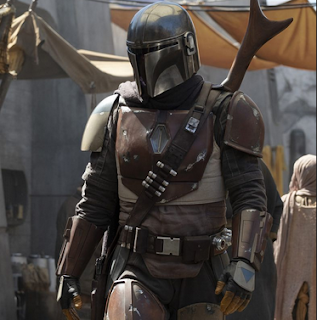
The Mandalorian: Star Wars Goes Spaghetti


Star Wars Mandalorian
The Mandalorian
Disney's made-for-tv venture into the world of Star Wars is a quick-fire, sure-fire, winner because it at once hooks into a myriad of cult classics. The plot centres on a bounty hunter operating at the fringes of the known universe.
   Firstly, there's his identity to be intrigued by. He's presented by his race--The Mandalorian--not by a personal name; ie this is tribal. He's an outsider, recognised by his armour, not by his face; and that armour! I don't know about you, but the helmet reminds me at once of both the ancient Spartans and the very modern Robocop.
   Character-wise, he's a high-plains drifter, cool, calm and collected with a smoking gun and very few words. He's good at what he does, which so far is mostly smoking bad guys and big monsters; but this is a series, not a film, and it's set in the Star Wars universe, where anything can be encountered and surprises are expected.
   Perhaps the biggest surprise so far is the appearance of a baby Yoda (we don't know yet if this is a baby from Yoda's species or even Yoda reborn). This is a possible masterstroke, since not only is the Yoda character much-loved, but everyone gurgles over adorable babies like this one--remember how adorable baby Groot was in Guardians of the Universe?
baby Groot

But there's more: baby Yoda has already saved the Mandalorian's butt, apparently through mind-control, but the baby overtaxed its strength and had to sleep for a while afterwards, thus revealing its weakness despite its strength.
   Of course it's a shoot-'em-up series and there have been a few pretty impressive shoot-'em-up scenes already. The very spaghetti-western showdown between nasty kidnappers on the one hand and the Mandalorian teamed up with a bounty-droid, is fun.

a bounty droid
The fact that the Mandalorian wastes the droid is interesting as well because he agreed on a 50-50 deal with the droid and then reneged on the agreement.

a baby Yoda
Is that because he has no morals or because by not killing the mark he's going to get a bigger reward? Or does he perhaps have feelings for this baby or curiosity about its nature? We don't know yet but it will be fun to see how it plays out.
   We can only hope that the series builds on this strong beginning. There is every reason why it should.

Thursday, March 16, 2017

This genius created modern fantasy but no-one has heard of him

A long time before JRR Tolkein wrote The Lord of the Rings, well before he even wrote The Hobbit, William Morris wrote and self-published his first fantasy novel set in a totally invented world, The Wood Beyond The World (left). It was 1895.
   Morris was famous at the time, a protean figure in Victorian England. He was an active socialist, painter, designer, and owner of the Kelmscott Press.
   But almost no-one knew that he had just invented a new genre, fantasy, that would spawn in later generations the work of such diverse creators as Tolkein, CS Lewis, JK Rowling, Neil Gaiman and George Lucas. He followed Wood  with The Well at the World's End (1896) and The Water of the Wondrous Isles (1897). Most likely he would have written more if death hadn't intervened.
   No-one knows why he wrote these late novels. Well is considered his masterpiece, and at the time was one of the longest stories ever written (228, 000 words). Tolkein's Lord is twice as long, but that was published as a trilogy. I've reread Well more times than I've reread Lord. It's a book to get lost in, full of characters and wonder. It's easy to see where it inspired Tolkein. In fact in one small section it includes a character called Gandolf, who does some magic... I also love his Wood and earlier The Story of the Glittering Plain. Lewis and Tolkein were members of a small literary club of professors and writers called The Inklings. They would get together and talk about literature and whatever they were working on at the time. Undoubtedly they discussed Morris. Lewis once said that after he discovered Morris he "got all the Morris he could get". You can get some here.

Tuesday, March 14, 2017

Why 'The Richest Man in Babylon' is one of the best financial books of all time

George S Clason's 1926 The Richest Man in Babylon has currently 505828 ratings and 2277 reviews on GoodReads and millions of copies in print. Clason originally composed it in parts, as a series of short pamphlets dispensing practical financial advice. Long hailed as a classic for all generations, it has been of inspiration and value to many many people. 
   But why is it so good? Yes, it offers practical and helpful advice; but so do many other books and they aren't as well-read or so famous. Is it that the advice is radically different from other books? No. In fact, some would say Clason's advice is homely and commonsensical rather than especially insightful. So what made it stand out and become viral in an age of print?
   Indeed, what makes this book still so special and so different from other books on similar themes? 
Quite simply, it's the power of story. Clason wasn't a brilliant financial advisor with insights unknown to others; he was a brilliant storyteller. This was his genius. The Richest Man in Babylon harnesses the potency of story. 
   We all of us love to hear and tell stories. If we didn't we wouldn't be human. Storytelling is primal.
   Consider the following books: 

  •  The Alchemist
  • The Monk Who Sold His Ferrari
  • Harry Potter
  • The Lord of the Rings
   and film and TV series like:

  • Star Wars
  • Star Trek
  • Game of Thrones

These are all fables and myths for a generation that grew up without fables and myths. Ancient Greece is considered the cradle of modern education as well as the foundation of our modern world, but do you know what the Athenian youth studied at school? They studied the Homerian myths--the stories of the Iliad and the Odyssey. These stories were more than just stories; they taught morality and character too. The Romans had the stories of Romulus and Remus, and the legend of Aeneas. The Jews had the stories compiled in Genesis, the Exodus, and the Judges.
   Here, in The Richest Man in Babylon, Clason creates a classic financial myth through careful and detailed elaboration of setting and skillful differentiation of character. He uses the powerful device of dialogue to share his ideas. Dialogue helps create character and thus personalises the teaching. Much of the dialogue uses question-and-answer (think Quora and Google) and throughout Clason understands how certain words and phrases trigger the reader's response to the text. Indeed, the storytelling techniques in this book are the same that drive our current social media and clickbait world.
   In short, The Richest Man in Babylon is a story with power because of the way it is told. It works like the telling of a good joke and is likely to endure for a long time to come.

Kenneth Rowley 2017

HAROLD BUDD: go in peace

Harold Budd Back in the 70s I had a friend called Howard, who lived in Wimbledon village, and we met regularly to listen to and discuss ou...